Rave music is experiencing a massive resurgence. From warehouses to festivals, the sounds of the early 90s are being revived and modernised by a new generation of producers. Whether you are making classic breakbeat rave, hard dance, or modern rave-influenced bass music, there are certain sounds and techniques that define the genre. Here is everything you need to know about producing rave music in 2026.
The Essential Rave Sounds
Rave music is built on a handful of iconic sound types. Get these right and you are 80% of the way to an authentic rave track.
Rave stabs
The rave stab is arguably the most recognisable sound in the genre. It is a short, bright, harmonically rich chord hit that cuts through everything. Classic rave stabs came from samplers like the Akai S1000 sampling Korg M1 and Roland JD-800 patches. To create modern rave stabs in a synth like Serum, use a saw or square wave with 4-8 unison voices. Add a short amplitude envelope with an instant attack, no sustain, and a fast decay of about 100-200 ms. Layer in a second oscillator slightly detuned. Add reverb with a medium decay for that spacious, warehouse feel. Play minor 7th or minor 9th chords for an authentic vibe.
Hoover sounds
The hoover bass is another rave classic. Named because it sounds like a vacuum cleaner, it is a brash, resonant, portamento bass sound. It originally came from the Roland Alpha Juno’s “What the” patch. To recreate it, use a pulse wave with fast pulse width modulation. Add portamento so the pitch slides between notes. Heavy resonance on a low-pass filter gives it that nasal, screaming quality. Add chorus for width. The hoover should be aggressive, in-your-face, and slightly out of control sounding. That is the charm of it.
Breakbeats
While four-on-the-floor kicks work for some rave styles, classic rave music is built on breakbeats. The Amen break, Think break, and Funky Drummer are the holy trinity of rave drum patterns. Chop them up, rearrange them, pitch them, compress them, and distort them. Modern rave production often layers programmed drums underneath a chopped break to add weight and consistency while keeping the organic feel of the break on top.
Acid Lines
The Roland TB-303 bass line is central to acid rave. That squelchy, resonant, sliding bass sound is instantly recognisable. You do not need a real 303. There are brilliant software recreations available. In Serum, you can approximate an acid line by using a saw wave through a resonant low-pass filter with envelope modulation. Set the filter envelope to a fast decay and crank the resonance. Use portamento for the classic slide between notes. The accent function is key. Accented notes should trigger a more aggressive filter envelope. Pattern the bass line with simple, repetitive note sequences and let the filter movement do the talking.
Build-Ups and Drops
Rave music thrives on tension and release. The build-up is where you create anticipation, and the drop is where you deliver the payoff.
Building tension
Use snare rolls that accelerate from quarter notes to eighth notes to sixteenth notes to thirty-second notes. Layer in a rising white noise sweep filtered with a high-pass filter that opens up over 8-16 bars. Add a pitched riser, a sine wave that slowly sweeps up in pitch. Cut elements out gradually, strip away the bass, then the drums, leaving just the riser and FX. The silence before the drop is as important as the drop itself.
The drop
When the drop hits, everything should come in at full force. Kick, break, bass, stabs, everything at once. Use a crash cymbal on beat one. Consider a half-bar of silence or a reverse cymbal right before the drop for maximum impact. The contrast between the sparse build-up and the full drop creates the energy that makes ravers lose their minds.
Tempo and Energy
Classic rave tempos range from 130 to 160 BPM depending on the subgenre. Happy hardcore sits at 160-180 BPM. Breakbeat rave at 135-145 BPM. Acid house at 120-130 BPM. Modern rave-influenced bass music often sits at 140-150 BPM, bridging the gap between DnB and classic rave tempos. Pick a tempo that matches the energy you want. Faster is not always better. Some of the most impactful rave tracks work at moderate tempos because they give the bass more room to breathe.
Arrangement Tips
Rave tracks tend to have simpler arrangements than other genres. The focus is on energy and repetition rather than complexity. A typical structure might be a 16-bar intro with drums building, a 32-bar section with the main groove, an 8-bar build-up, a 32-bar drop, a 16-bar breakdown, another build and drop, and a 16-bar outro. Keep the arrangement moving by introducing and removing elements every 8-16 bars. A new percussion loop, a filter sweep, a vocal sample, these small changes keep the energy building without overcomplicating things.
Effects and Processing
Reverb is essential for rave music. That warehouse, cavernous space is part of the sound. Use a medium to large reverb on stabs, vocals, and snares. Keep the bass relatively dry to maintain low-end clarity. Delay is useful for creating rhythmic interest on stabs and vocal chops. A ping-pong delay synced to your tempo adds width and movement. Distortion and saturation add aggression to everything. From subtle warmth on pads to full-on destruction on bass sounds, distortion is your friend in rave production.
Modern Rave Production with Serum
Serum is perfectly suited for creating rave sounds. Its wavetable synthesis can replicate classic analogue textures while adding modern sound design possibilities. The macro controls let you morph between clean and aggressive versions of a sound in real time. The effects chain can handle everything from subtle reverb to devastating distortion.
The Dirty Rave Hitters Vol 1 pack from Preset Drive is specifically designed for modern rave production. It includes rave stabs, hoover basses, acid-influenced leads, and hard-hitting bass sounds that capture the energy of the genre. Every preset has mapped macros for real-time performance control.
Finding Your Rave Sound
The beauty of rave music is its raw energy and lack of pretension. It does not need to be technically perfect. It needs to make people want to move. Focus on energy, impact, and groove. Use the techniques above as starting points and develop your own style. The rave scene has always been about individual expression within a framework of shared energy. Make tracks that you would want to hear at 3am in a dark room with a massive sound system. That is all the guidance you need.
For more rave-ready sounds and production tools, visit Preset Drive.
PHP: 2026-03-15 12:34:30 [notice X 0][/var/www/presetdrive/wp-content/plugins/elementor-pro/modules/forms/submissions/actions/save-to-database.php::193] {closure:ElementorPro\Modules\Forms\Submissions\Actions\Save_To_Database::__construct():193}(): Implicitly marking parameter $exception as nullable is deprecated, the explicit nullable type must be used instead [array (
‘trace’ => ‘
#0: Elementor\Core\Logger\Manager -> shutdown()
‘,
)]
For a complete overview of dirty bass sounds and preset recommendations, see our Dirty Bass Serum Presets guide.
Ready to level up your sound?
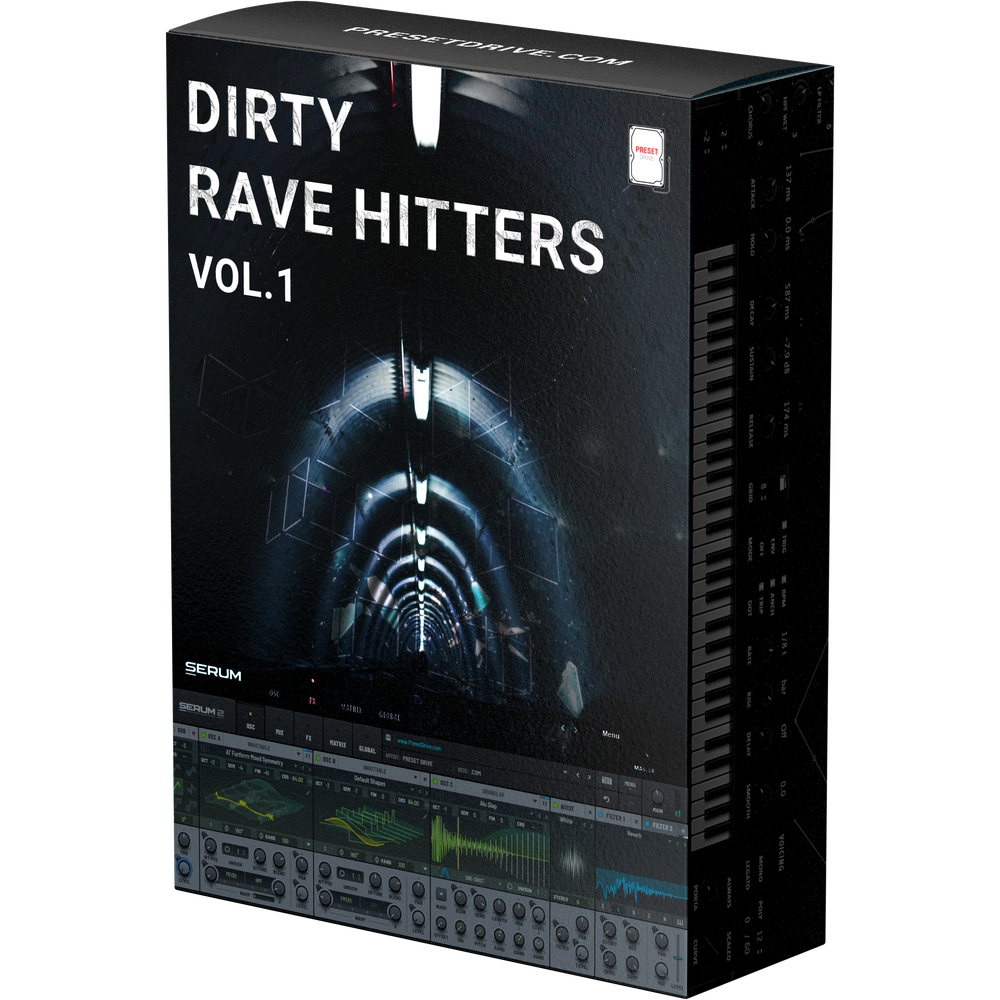
Dirty Rave Hitters Vol.1
Hard-hitting rave presets designed for maximum dancefloor impact.
£29.99
Shop Now →Not sure yet? Grab our free taster pack first.


