Why Drum Programming Defines DnB
In drum and bass, the drums are not just accompaniment. They are the centrepiece. The genre gets its name from the two most important elements: drums and bass. Getting the drum programming right is non-negotiable. A weak drum pattern makes even the best bass design fall flat. A tight, grooving break pattern makes everything on top of it sound better.
DnB drum programming draws heavily from breakbeat culture, where sampled drum breaks are chopped, rearranged, and layered to create patterns that groove and drive at 170-180 BPM. Here is how to program drums that actually move.
Understanding the DnB Beat Structure
The Two-Step Foundation
Most DnB patterns are built on a two-step foundation. The kick usually lands on beats 1 and 3 (or 1 and the “and” of 2). The snare lands on beats 2 and 4. This simple framework creates the forward-driving energy that defines the genre. Everything else, hi-hats, ghost notes, percussion, is decoration on top of this foundation.
At 170-180 BPM, this two-step pattern creates a unique half-time feel where the snare hits feel slower than the actual tempo. This is part of what gives DnB its distinctive bounce. The fast tempo creates energy and urgency while the half-time backbeat gives the groove a sense of swagger.
Kick Placement Variations
The basic kick on beats 1 and 3 works, but professional DnB pushes the kick to more interesting positions. Try the kick on beat 1 and the “and” of beat 2 for a more syncopated feel. Or use a kick on the “and” of beat 3 for a skippy, rolling pattern. Ghost kicks (quiet kicks between the main hits) add subtle forward momentum.
Program your kick pattern first, then build everything else around it. The kick and snare relationship is the skeleton of your beat. Get this right before adding hi-hats and percussion.
Breakbeat Chopping Fundamentals
Classic Breaks
DnB was built on chopped breakbeats. The Amen Break, Think Break, Apache, and Funky Drummer are the DNA of the genre. While using these exact breaks can sound dated, understanding how they work is essential for programming convincing DnB drums.
Load a breakbeat into your sampler and slice it into individual hits: kick, snare, hi-hats, ghost notes, and incidental sounds. Rearrange these slices into new patterns while maintaining the organic feel and sonic character of the original break. The individual hits from a real breakbeat have room ambience and bleed that give them a natural, cohesive sound that programmed samples often lack.
Layering Breaks with One-Shots
Layer your chopped breaks with clean, punchy one-shot samples for weight and impact. Use the break for groove, texture, and character. Use one-shots for punch and clarity. A chopped Amen snare layered with a modern, processed snare sample gives you the best of both worlds: vintage character with modern punch.
High-pass the break at around 200-300Hz and use it primarily for mid and high-frequency texture. Let your one-shot kick and snare handle the low-end weight. This layering approach prevents the low frequencies from getting muddy while preserving the organic feel of the break.
Hi-Hat and Percussion Patterns
Hi-Hat Programming
Hi-hats in DnB typically run in 8th or 16th note patterns with velocity variation for groove. Do not program every hit at the same velocity. Alternate between loud and quiet hits to create a natural, humanised feel. Emphasise the off-beats for a shuffled groove or the down-beats for a driving, straight feel.
Use multiple hi-hat samples (open, closed, half-open) and alternate between them for realism. An open hi-hat before the snare hit is a classic DnB move that adds energy and anticipation. Close the hi-hat on the snare hit for a tight, controlled sound.
Ghost Notes and Fills
Ghost notes are quiet snare hits between the main backbeats that add groove and complexity. Program ghost notes at 20-40% velocity on the off-beats around your main snare hits. These subtle hits create a rolling, busy feel without cluttering the pattern.
Drum fills mark transitions between sections. In DnB, snare rolls that accelerate from 16th notes to 32nd notes (or even 64th notes) create intense, building energy before drops and transitions. Use velocity ramping (gradually increasing volume) for natural-sounding fills.
Processing DnB Drums
Compression and Parallel Processing
DnB drums need to hit hard. Use bus compression on your drum group with a fast attack to catch transients and a medium release. Parallel compression (blending a crushed signal with the clean drums) adds density and sustain without losing the transient punch that DnB requires.
Saturation and Width
Light saturation on the drum bus adds warmth and glue. Use tape or tube saturation for a warm character. Keep the stereo width of kicks and snares narrow (mono or near-mono) while spreading hi-hats and percussion wider for a balanced stereo image. Our bass preset collections are designed to sit perfectly alongside well-programmed DnB drums.
Programme Better Breaks Today
DnB drum programming is a deep skill that improves with every beat you make. Start with the two-step foundation, add ghost notes and hi-hat variations for groove, and process with compression and saturation for punch. Study the drum patterns in your favourite DnB tracks and try to recreate them in your DAW.
Pair your drum programming with professional bass sounds. Download our Serum taster pack and build a complete DnB track with tight drums and heavyweight bass.
Get sounds that already sit in the mix
Skip the sound design. Our Serum packs and one-shots load straight into your DAW so you can finish a track tonight.
Ready to level up your sound?
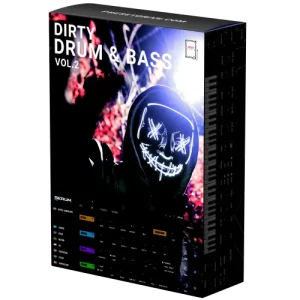
Dirty Drum & Bass Vol.2
Professional DnB presets for Serum. Reeses, neuro basses, subs, and more.
£29.99
Shop Now →New here? Start with our one-shots pack first.

